
Kim Han
Icon of Canada's North


Photo by Ed Maruyama

About the Book
The Canadian Inuit Dog: Icon of Canada's North
By Kim Han
As ruggedly beautiful as the circumpolar north in which it evolved, the Canadian Inuit Dog has been a vital partner to the Arctic's indigenous people for millennia, helping them navigate, hunt and survive their frozen world. The Canadian Inuit Dog: Icon of Canada's North is an in-depth look at this ancient landrace, which predates modern breeds like the Siberian Husky and Alaskan Malamute. A deft and deeply-researched exploration of this aboriginal canine's history, genetics, form and function, this new book by Kim Han also chronicles the Inuit Dog's clashes with modernity, which threatens its existence more ominously than any Arctic blizzard.
Get ready to embark on a journey through the frozen landscapes of the Arctic and discover the incredible history and role of the Canadian Inuit Dog. This powerful breed has been a vital companion to the indigenous people of the north, aiding them in their survival and providing a glimpse into the past. In this book, you will learn about the Inuit Dog's genetic makeup, physical traits, and its struggle to adapt to the modern world.
- Uncover the fascinating history of the Canadian Inuit Dog and its deep connection to the Arctic's indigenous people.
- Experience the emotional bond between the Inuit Dog and its human companions, and how this relationship has shaped the breed.
- Discover the unique physical features and abilities of the Inuit Dog that make it a perfect companion in the harsh Arctic environment.
- Learn about the challenges and threats facing the Inuit Dog in the modern world, and how we can protect this ancient landrace.
- Gain a deeper understanding of the cultural significance of the Inuit Dog and its role in the traditional way of life in the Arctic.
All proceeds from the book will be donated to Ilisaqsivik, a non-profit Inuit charity by Inuit for Inuit.
This book is a must-read for anyone interested in the history and evolution of the Canadian Inuit Dog. From its origins to its current state, you will be captivated by the stories and insights shared within these pages. Buy now and join the journey through the frozen north.
The Canadian Inuit Dog: Icon of Canada's North is Print On Demand and is not available in bookstores but can be ordered online, anywhere in the world, at Amazon, Barnes and Noble, Chapters/Indigo or from the publisher, Revodana publishing.
About Canadian Inuit Dogs

"Rough Ice" from a painting by Germaine Arnaktauyok
During the last Ice Age, more than 15,000 years ago, the Bering Land Bridge emerged between Siberia and Alaska when sea levels dropped, linking Asia and North America. It is widely accepted that the Bering Land Bridge was the most probable migratory route of colonizers from Asia into North America.
Together, humans accompanied by their dogs, braved extreme weather and living conditions in a challenging environment where the basics of daily life were often in short supply.
Their close association and ability to depend on each other became a partnership in a quest for survival that made the difference between life and death.
Known as qimmiq, these dogs evolved in large part by natural selection, where only the strongest survive. They were Inuit's hunting and working companions and served as guardians and protectors of the humans with whom they lived. Based on archaeological findings, qimmiq has been in Canada's Arctic since the earliest Paleo-Inuit hunters arrived in the New World more than 4,000 years ago.
It wasn't that long ago when the survival of Inuit living on the edge of the top of the world depended on qimmiq. As recently as the 1960s, qimmiq was still essential for many Inuit's semi-nomadic way of life. Together, man and dog travelled the Arctic in search of food, following the seasonal movement of the animals they hunted on land and at sea. Inuit would evaluate what their dogs were doing against what they thought was the course of action. Many a tale has been told about the lives qimmiq has saved. Qimmiq earned himself a place in the hearts, history, culture and traditions of Inuit, and on May 1, 2000, the Legislative Assembly of the government of Nunavut, with the official herald of Canada, designated qimmiq as its official animal symbol and named it Canadian Inuit Dog.


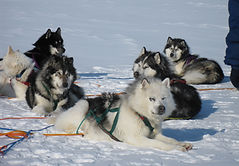
Photos by Debbie McAllister, Calgary

Photo by Fred Lemire, Iqaluit
Photo by Elise Maltinsky
Photo by Debbie McAllister
Photo by Siu-Ling Han